
Blog of Material Processes
This reflective blog features daily or weekly reflections on the project "Interwoven Peaks", to highlight techniques I have learned, experimentation with materials, process of making stages and testing out installations and sited work.
Natural shapes and Forms on Werneth Low
Today, I went on a walk to Werneth Low, a hill close to where I live, which provides a great view of the Peak District. It was interesting to see all of the organic shapes and formations that the Peak District has to offer as well as the flora found on Werneth Low. I did some quick sketches and took many photographs, as the colours of the flora intrigued me. There were many shades of purple, pink and red, which aren't typically seen as 'natural colours'. I am interested in incorporating these colours into the woven pieces, and aim to challenge the conventions of what is seen as natural versus synthetic.


Colours of the Peak District
I took a few of the photos I took on my journey, roaming the Peak District and created some colour palettes using Adobe, in order to inform my choices of yarn colours. The colours of my yarn are also important, as I want the final piece to feel like it has come from the Peak District.
It may be difficult to find the exact colours of fibre, especially from second-hand sources. However, if I find similar colours, I will use them, as the ethicality of how I am sourcing my yarn outweighs the colour in importance.
It was useful to pinpoint colours from a photograph; however, as they may have been missed and I do think that the colours I have picked out work well and compliment each other, and represent the landscape well.


Peak District Patterns: An Aerial View of Patterns in the Hills.
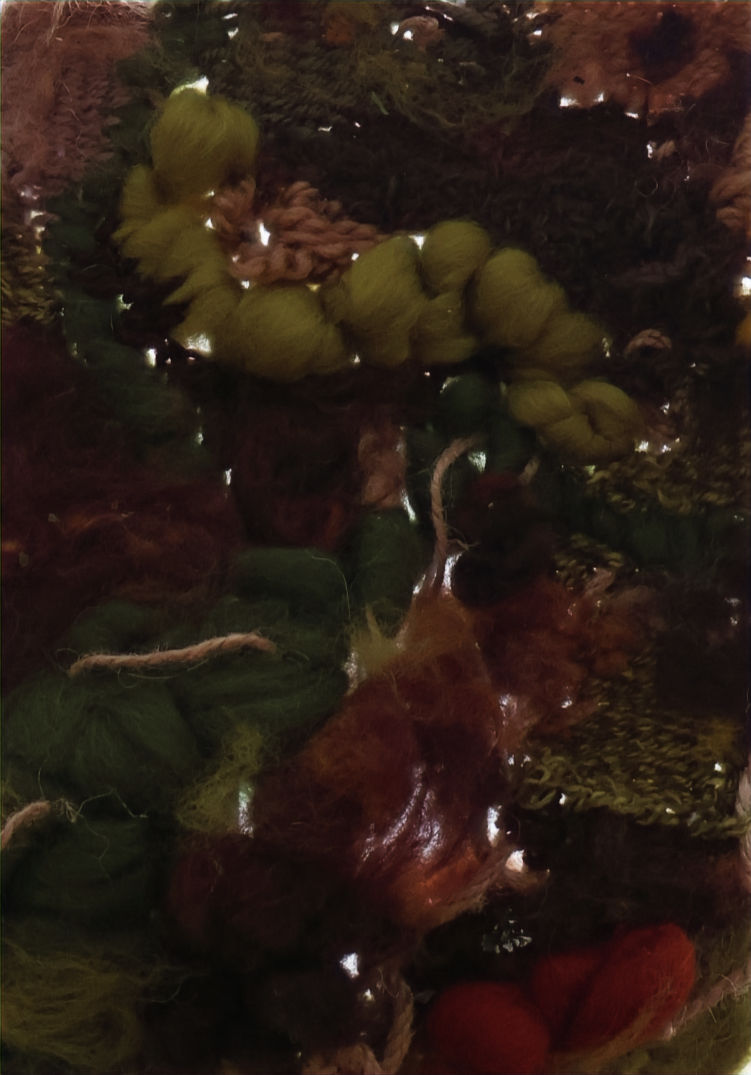
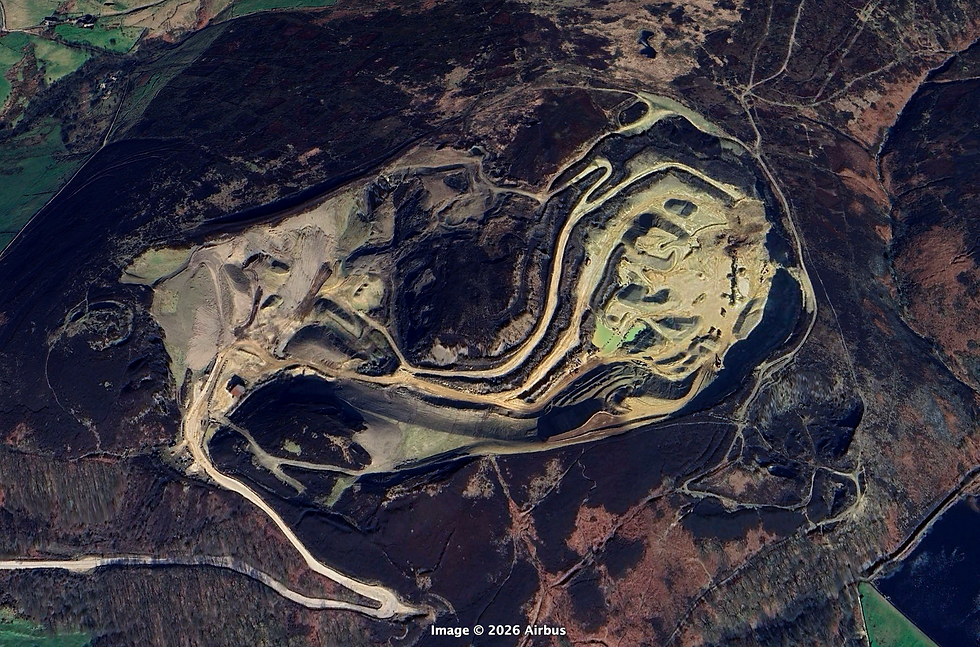
A realisation that I made during my research was my subconscious interest in maps and contours. This was realised in my textural woven piece (pictured below), in which I created a tapestry inspired by the leaves I photographed on a walk. My tutor pointed out that this reminded her of contours and maps of the landscape of the whole, so I thought it would be interesting to see what patterns I could find in the Peak District, using Google Earth. I noticed that the textural weaving I created, inspired by the leaves and sticks on the ground, also resembled the satellite photographs. This means my weavings could become more abstract, representing and depicting both the micro and the macro.
Photographs taken from Google Earth




Sourcing Recycled Yarn
After my tutorial, I have done some thinking about how I could source recycled yarn sustainably. This included buying yarn made from recycled materials or 100% wool yarn, as it is self-sustaining and doesn't harm the sheep. However, this could become quite costly, as I aim to weave my pieces on a much larger scale. To resolve this, I thought of sourcing my yarn second-hand, from jumpers or yarn skeins in charity shops or waste, therefore it is sustainable, as I am reusing otherwise discarded materials and is cost efficient, as I would be sourcing them at heavily discounted prices or free.
Some Photographs below show some yarn I have collected, which are inspired by colours in my landscape.


Weaving: Week One
Once I had collected my recycled yarns, I began to weave the patterns and colours of the aerial photographs. I wanted to start experimenting further with texture in my woven pieces, making use of the different weaves I learned, such as soumak, Egyptian and rya knots and looping. The idea is to create several large-scale weavings on the loom, piece them together in a patchwork-like tapestry and explore form and the landscape through an installation, where the piece is draped to represent the hills and contours of the Peak District.

Woven Patchwork Paintings
Today I painted some of the satellite photography in watercolours. This was to practice and observe some of the intricate patterns in the landscape, which will help me a lot when weaving them, as I now know how to form them with the thread. I also experimented with manipulating them into forms, around branches, to mimic the organicness of nature and create maquettes of possible larger-scale pieces. I really enjoy how abstract these paintings are, yet still symbolise the unique landscape which is the Peak District.
Below are some photographs of the individual paintings and the sculptures made from them.


Weaving: Week Two - Finding Form with Weaving
This week, I took my first woven piece and started experimenting with how I could create a 3D form with a 2D tapestry. On my Walks, I have collected various branches, logs and twigs with unique organic shapes, which remind me of the folds and crinkles in the Peak District hills. I have thought about playing around with attaching the tapestry to these and exploring how they manipulate the tapestry from a square into an organic shape that reflects the environment around me.
I created some sketches of possible ways i could install this sculpture:
 |  |  |
|---|
From these sketches, I was able to visualise how I could display my tapestry. I want to create multiple versions of these, in order to create an immersive tunnel or landscape inspired by Alexandra Kehayoglou. These foraged branches will form the backbone of the landscape, as the trees which help us survive do.
Below are some experiments with manipulating the tapestry to form the hills in my landscape.


Mid Module Review and Project Proposal
My Mid-Module Review provided a lot more insight and inspiration on how I can display my work in the Degree Show. I really like the idea of Draping and Suspension. This means a more natural way of hanging and a play with nature and the landscape, with how the weaving reacts to gravity when suspended. I also like the idea that the piece can be viewed from different angles, immersing the viewer, which plays on the idea of the landscape surrounding the person.
I was also suggested to take the woven piece back into the environment, and see how it interacts with dirt, leaves and the land. I believe that this may add elements of the landscape to the piece itself and also remove the 'clean and manufactured' aesthetic of the piece, so it speaks the language of the Peak District more.

Sculpture Building: Tree Armature
Today, I went home, back to the Peak District and started to create a tree sculpture from tree roots, branches and stumps that I had collected from across the landscape. I arranged the pieces in size order, from the heaviest, widest pieces, to the smaller, more intricate pieces, to form a tree-like armature for my weavings to be formed around. I was more interested in the more warped and interestingly shaped logs and branches, rather than the straight ones, as they would create more folds and creases in the tapestry, reflecting the rolling hills of the Peak District.
My initial idea was to use threaded rods and inserts to attach the pieces of wood. This way, I could take them apart for transportation and ease of lifting each part when they are being displayed and suspended. However, this wasnt as possible as I first thought, as some pieces of wood were rotten and would not be strong enough to have a metal rod inserted without splintering or breaking apart. Instead, I used nails, screws, and wood glue to attach segments, which were still manageable to transport and lift. Aesthetically, I am not totally pleased with the outcome. I think it looks quite messy. However, I can appreciate the sculpture in context, how the tree is pieced together, quite obviously by humans, with the fixings used to represent the human touch on nature and question what nature really is.
In the show, I would prefer to hide or work on these imperfections so that the piece looks more refined and professional. However, I must be careful not to remove that sense of human interference in the piece.
Photographs by Joe


Weaving Week Three: Natural vs Synthetic
Conversations arose about how I can incorporate both natural and synthetic materials into my work to create a stronger contrast between nature and human intervention in my work surrounding the Peak District. I created two small weavings, with differences in how much I used natural and synthetic materials.
I think that the variations in textures are very successful in these pieces as they create a strong visual and tactile contrast. This provides further depth and a visual interest, while maintaining cohesion and meaning.


Weaving Week Four: Playing with Scale
I knew from the beginning of this project that I wanted to create a large-scale weaving. Immersing people in the landscape in which I feel a connection is important to communicate my themes of human impact and reshaping the environment of the Peak District. I continued to use the custom-built loom to create 'patchwork' pieces, which I would sew together to create a large-scale piece and enlarge 'Margery Hill' to create a topographical map of textures in the Peak District. This would then be sewn onto and suspended from the large, tree sculpture, which was foraged from the Peak District.

Degree Show: Set up Plan
As my exhibition space for the Degree Show was finalised, I took photographs and measurements to begin curating it. The space was quite large, and the walls were spread out, meaning that the photographs needed a space where they could all be together. The photographs were very successful in the alcove, as the spotlights were directly central to the partition wall, and where the photographs would be hung, allowing for professional lighting. The photographs are also matte, with a perspex front, so the spotlights would not create glare and would allow the true colours of the weaving to come through. I decided to display them in a 'strip' as this creates a narrative of the piece's journey around the Peak District.
I also decided that instead of the woven tapestry being installed perpendicular to the wall, it would be more effective if the wooden beam was moved diagonally across the space, to enclose the bare, white walls and provide a sense of immersion, inviting the viewer into not only the space, but the Peak District.
