
Lines
Tim Ingold
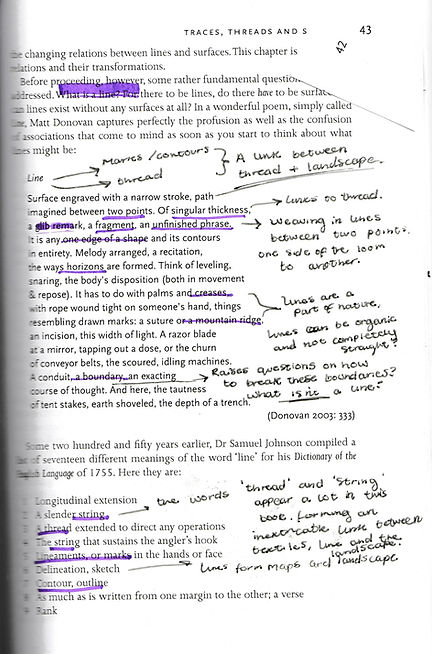


"Lines" by Tim Ingold is another book that has shaped my practice and thinking. The book explores how human life, movement and the landscape are shaped through lines. The book also mentions how the storytelling of walking and weaving unfold along lines. There are two key ideas mentioned in this book: threads and traces. Threads are lines woven together, such as fibres, paths, rivers, and walls. Traces are marks left by movement, such as drawings or footprints. Ingold suggests that the world is interconnected through these pathways and movements, which my woven pieces convey through the intertwining of different coloured and textured threads, forming a landscape.
The book argues that reducing life to straight lines can have negative impacts. Borders, walls, and rigid structures can cause societal separation, leading to war, famine, and poverty, which in term has negative impacts on the environment. Wandering, weaving and wayfaring can transform human existence, which is what my woven tapestries intend to do, by wandering with my thread, rather than weaving in straight lines, uneven and tangled ends, to reduce the hard edges. I also achieve this by forming and draping the weaving into natural positions, which are dictated by gravity, in order to revolt against rectilinearity.


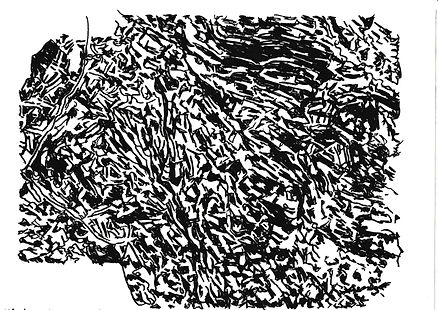
Sketches of the "Human Trace" in the Peak District, highlighting patches where heather has been burned or cut down. These sketches were inspired by Tim Ingold's underground path drawings. The darker areas represent the natural, untouched landscape, whereas the white areas or those that have been 'left blank', represent human intervention on the landscape. It is interesting how I have chosen to leave blank the areas, which have been interfered with, suggesting that it is no longer 'real nature'.


Book: Lines by Tim Ingold, Annotations and Drawings by me.